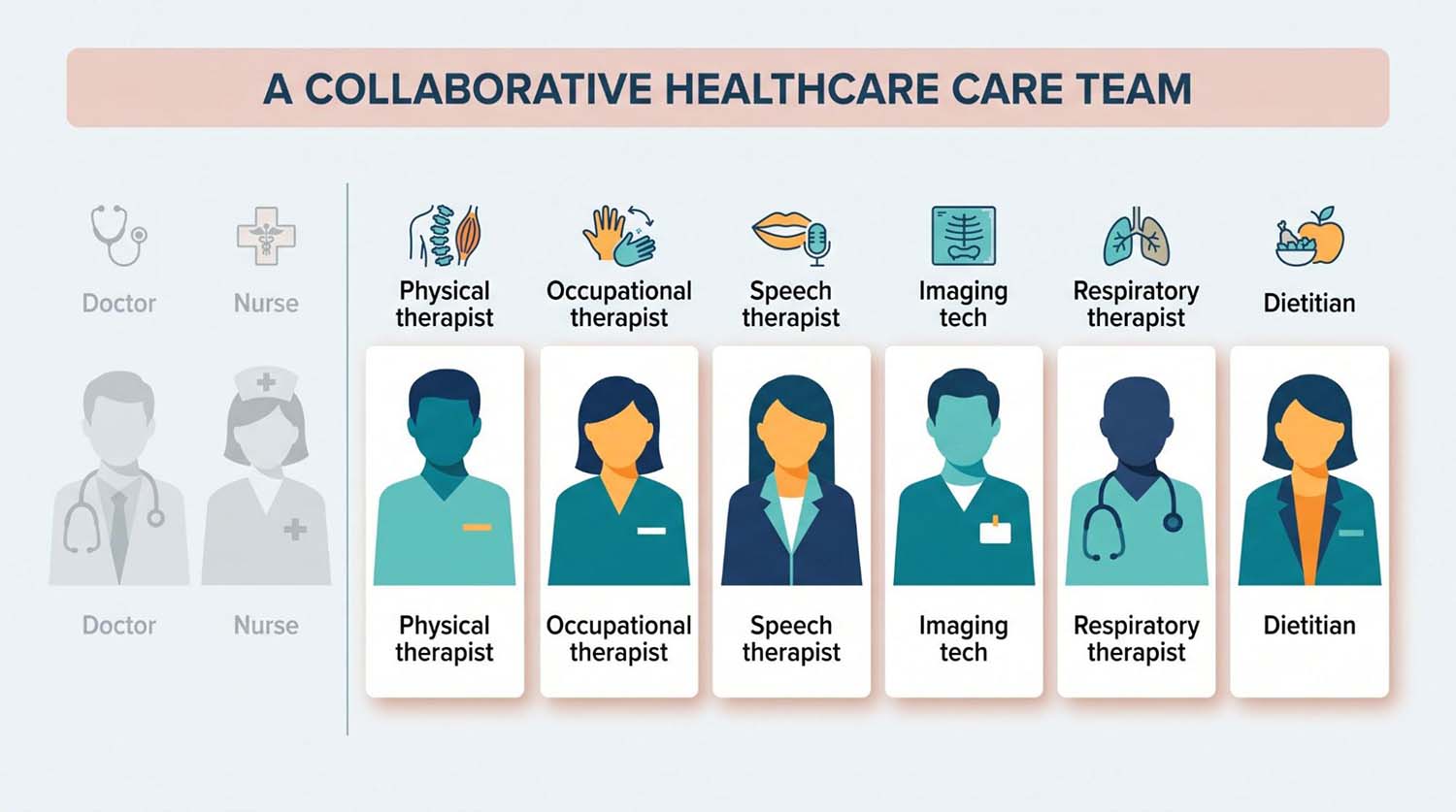
 Not doctors, not nurses. The therapists, technologists, and technicians who make up most of the clinical care team, and a growing share of how people stay well.
Think back to the last time you or someone close to you needed real medical care. Odds are a doctor set the plan and a nurse managed the ward. But a lot of the hands-on work came from someone else entirely. Think of the person who ran the scan, guided the rehab, managed the breathing treatment, or built the nutrition plan. Those professionals belong to a broad field that quietly does much of modern healthcare, and it is expanding faster than almost any corner of medicine. Understanding what it is makes the whole system easier to navigate, and it explains a lot about how people actually recover, stay mobile, and keep feeling well.
What allied health actually is
Beyond the doctor and the nurse, a broad team of therapists, technologists, and technicians delivers much of everyday care.
The term sounds technical, but the idea is simple. Allied health refers to the large group of licensed clinical professionals who are not physicians and not nurses, yet deliver a huge share of direct patient care. It includes physical, occupational, and speech therapists, radiology and imaging technologists, respiratory therapists, medical laboratory technicians, dietitians, and many more. Together these roles make up a majority of the healthcare workforce, which surprises most people the first time they hear it. Each one requires its own training, license, and scope of practice, and each handles a specific piece of care that a doctor or nurse typically does not. They are experts in movement, imaging, breathing, diagnostics, and nutrition, working alongside the rest of the team rather than beneath it. This kind of coordinated, professional approach to personal wellness is exactly what sets allied health apart from a DIY approach to staying healthy.
The allied health roles you actually encounter
Most people meet several of these professionals without ever registering the umbrella term that connects them. A twisted knee sends you to a physical therapist; a stroke recovery involves both occupational and speech therapists; a routine chest complaint might bring in an imaging technologist and a respiratory therapist on the same day. The table below lays out the roles you are most likely to encounter, what each one does in plain language, and the moment you tend to cross paths with them.
Role
What they do
When you meet them
Physical therapist (PT)
Restore movement and manage pain
After an injury, surgery, or a mobility problem
Occupational therapist (OT)
Rebuild daily-living skills
During recovery from stroke, injury, or illness
Speech-language pathologist (SLP)
Treat speech, language, and swallowing
After a stroke, or for a child’s development
Imaging technologist
Run X-ray, CT, MRI, and ultrasound
Whenever a diagnosis needs a look inside
Respiratory therapist
Manage breathing and ventilators
During a